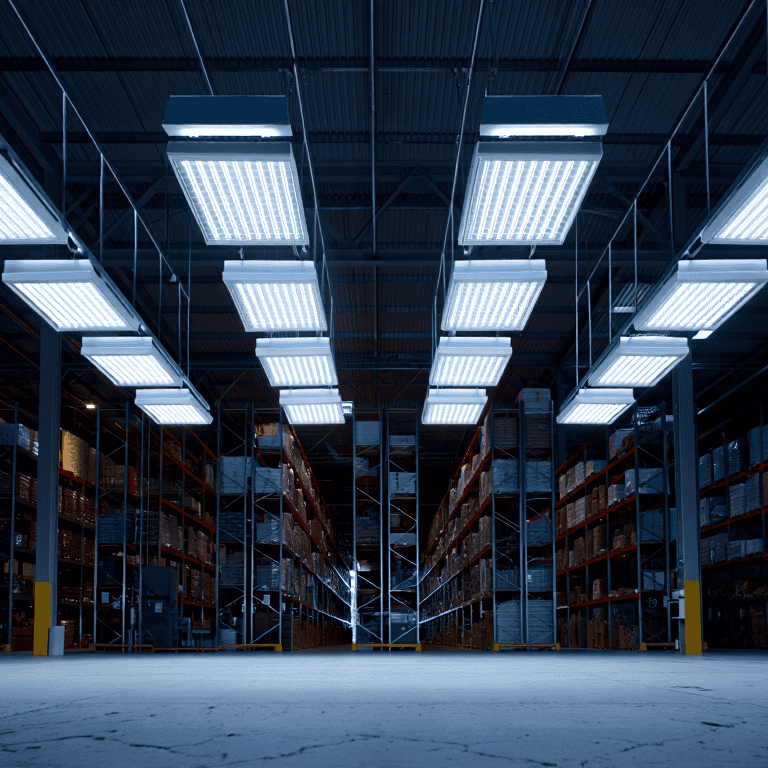
LED High Bay Procurement Is a Lighting Design Decision
A warehouse manager notices the difference between lighting that looks bright from the doorway and lighting that lets staff read labels safely between high racks.
Warehouse managers do not buy luminaires just to collect a high lumen figure. They need enough light on shelves, floors and work surfaces, with acceptable glare and predictable maintenance in a working space.
An LED high bay light manufacturer should help buyers review mounting height, beam angle, aisle geometry and task illuminance. A narrow optic can increase useful light on a tall rack while creating unwanted dark zones elsewhere.
An LED high bay light manufacturer should provide photometric files for the proposed luminaire and beam distribution, not only a wattage comparison. In tall-rack warehouses, narrow aisles and workstations demand different light patterns. Poor uniformity can leave workers moving between dark and bright patches even when the average lux figure looks acceptable.
Maintenance planning includes driver accessibility, thermal conditions near the ceiling and replacement availability. Check whether efficacy figures describe the whole luminaire or the LED chips alone, and assess glare where forklift operators look upward. The right fixture layout is a design decision tied to the building.
Efficiency claims need context: input power, operating temperature, driver losses and lumen maintenance all shape lifetime energy use. Buyers should look for relevant test documentation rather than extrapolating from nominal chip ratings.
Controls can matter as much as fixture efficiency. Occupancy sensors, daylight control and scheduling reduce burn hours, but their settings should fit forklift movement and safety requirements. The comparison becomes fairer when recurring costs are spread over the realistic service period instead of judged from a single invoice.
Request photometric files, wiring details, surge protection information and warranty conditions before ordering. A trial installation in one representative bay can reveal glare, shadows and installation problems a product brochure will not show.
When reviewing LED high bay, turn the operating points above into a short written checklist. Record the intended use, acceptance criteria, responsibilities, and evidence needed before approval. This gives everyone a common reference when the quotation, sample, installation, or delivered result is reviewed.